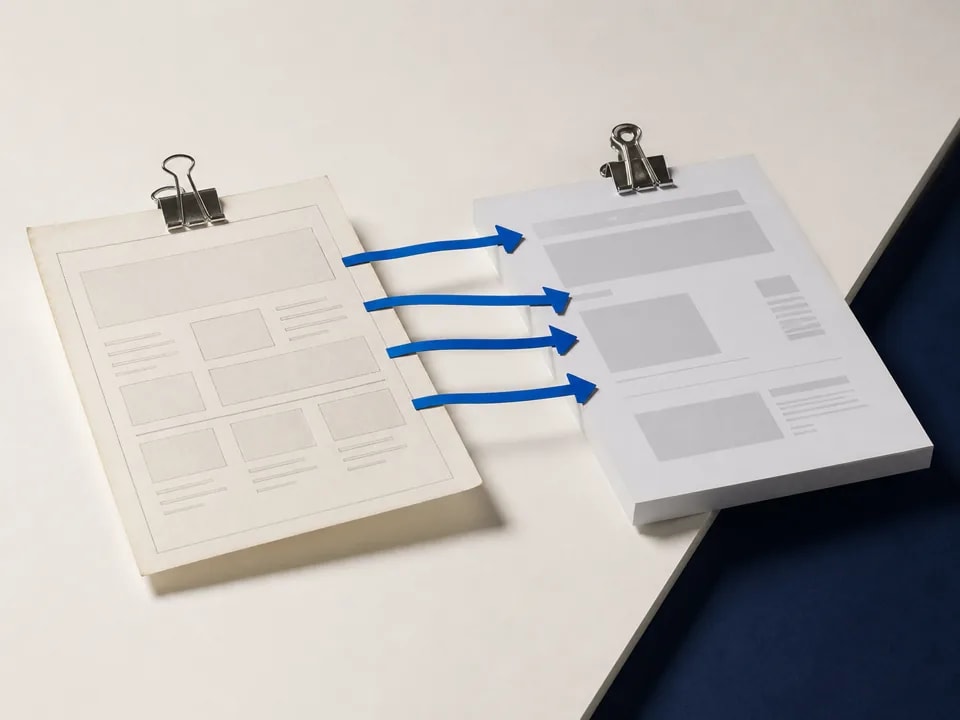
Redesign around evidence of friction, not a calendar reminder.
Some websites remain effective for years with steady maintenance and focused improvements. Others become obsolete quickly because the offer, audience, technology or internal publishing needs have changed. An arbitrary replacement cycle ignores that difference.
Start with a review of business fit, user journeys, content, analytics, search visibility, accessibility, performance and technical health. The result may justify a full redesign, a structural rebuild, a visual refresh or a smaller programme of fixes.
How often should a business website be redesigned?
There is no universal redesign interval. Review the website regularly and redesign when evidence shows that its structure, technology or visual system can no longer support the business and users effectively. Changes to positioning, services, customer behaviour, content operations or critical integrations are stronger triggers than age alone. If focused improvements can solve the problem safely, a full redesign may not be necessary.
Look for signals that affect outcomes or operations.
A redesign earns its cost when it addresses a material problem. Collect examples from customers, staff, analytics and the people maintaining the site.
The offer has changed
New services have been added wherever space was available, important distinctions are buried and the navigation reflects an older business. This usually needs content and structural work before a visual direction is chosen.
Important journeys are hard to complete
People cannot compare services, understand the next step, use the site comfortably on mobile or complete a form. Record the journey and failure point rather than reducing the problem to a vague conversion-rate target.
Routine changes create risk
Publishing is inconsistent, layouts break when copy changes, only one person understands the system or every update needs developer intervention. A better content model may be as important as the front-end redesign.
The technical foundation is constraining work
Unsupported dependencies, slow delivery, fragile integrations or inaccessible interaction patterns can make incremental fixes disproportionately expensive. Validate the extent of the problem before assuming the whole system must be replaced.
Audit what should be protected as well as changed.
An existing website contains accumulated value. Treat content, URLs, data and working journeys as assets to be assessed, not clutter to be discarded.
Business and audience fit
Confirm the current offer, priority audiences, objections, evidence and actions. A redesign cannot create a stable hierarchy while the business is still asking every message to be equally prominent.
Content and search demand
Inventory useful pages, rankings, backlinks, enquiries and content gaps. Identify which URLs need to remain, merge or redirect so the new structure does not erase discoverability that already works.
Experience and accessibility
Review navigation, reading order, keyboard use, forms, contrast, zoom, motion and mobile behaviour across complete tasks. Automated scores are helpful evidence, but they do not replace manual judgement.
Technology and operations
Map the content system, integrations, analytics, consent, hosting, deployment, backups and support process. Decide which problems belong to design, which belong to technology and which belong to ownership.
Match the intervention to the problem.
A full redesign is one possible route. The audit should make a smaller, safer option visible when it can deliver the same useful outcome.
Focused optimisation
Improve a high-value journey, repair accessibility issues, refine key content or address a performance bottleneck while the wider structure remains sound. Define the measurable problem and avoid endless disconnected tweaks.
Visual refresh
Update typography, colour, imagery and component styling when the brand expression has moved but the page structure and technology still serve the business. Test contrast, states and responsive behaviour as part of the change.
Structural redesign
Rework the hierarchy, page types, navigation and conversion routes when the content model no longer explains the business. The technical platform may remain if it can support the new system cleanly.
Full rebuild and migration
Replace the technical foundation when it blocks required functionality, editing, assurance or support. Plan URL mapping, redirects, content migration, analytics and rollback before the new site becomes the only copy of the work.
Turn the audit into a redesign decision.
Write down the evidence, proposed change and protection needed. This prevents an aesthetic preference from silently becoming a complete rebuild.
Business problem
What outcome, offer or operating need can the current website no longer support?
User evidence
Where do real visitors lose understanding, confidence or the ability to complete an important task?
Existing value
Which pages, URLs, content, integrations and journeys already work and must be protected?
Change boundary
Can focused improvement solve the problem, or do structure and technology also need to change?
Migration risk
What redirects, data transfer, analytics, consent, testing and rollback work will launch require?
Post-launch owner
Who will monitor performance, fix issues, maintain the system and decide the next improvement?
Sources and further reading.
These primary sources inform the guidance above. Your project may need additional legal, security or accessibility advice for its own context.
Site moves and migrations
Google Search Central: Technical guidance for changing URLs while reducing avoidable disruption to crawling, indexing and search visibility.
Web Content Accessibility Guidelines (WCAG) 2.2
W3C: The W3C Recommendation defining testable criteria for making web content more accessible to people with disabilities.
Find the smallest redesign that solves the real problem.
Subtle Standard can audit the current website, define what should be protected and shape a redesign or rebuild around the evidence rather than its age.
Website redesign questions.
Is an old-looking website enough reason to redesign it?
It can be a signal, especially when the visual presentation weakens trust or no longer represents the business, but appearance alone does not define the scope. Review the offer, journeys, content, accessibility, performance and editing process first. A visual refresh may be enough if the structure and technology remain dependable.
Can a website redesign hurt SEO?
Yes, if useful content is removed, URLs change without correct redirects, internal links weaken, pages become harder to crawl or technical controls are misconfigured. Risk can be reduced with an inventory, URL map, redirect plan, metadata review, crawl checks and post-launch monitoring. Search fluctuations can still occur while changed pages are recrawled and reassessed.
Should I redesign or improve the current website?
Improve the current site when the underlying structure and technology can support the required outcome safely. Redesign when the hierarchy, interface system or platform repeatedly blocks important changes. Compare the cost, risk and lifespan of a focused improvement programme with the work of rebuilding and migrating before deciding.
What should be measured after a website redesign?
Monitor the outcomes tied to the original problem, such as completion of important journeys, qualified enquiries, content engagement or reduced support demand. Also watch crawl and index coverage, priority rankings, redirects, errors, performance, accessibility and form delivery. Compare like periods carefully and annotate the launch so later analysis has context.